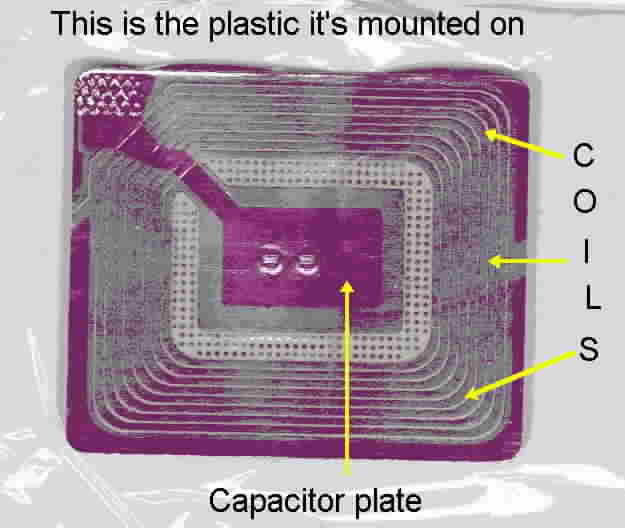
The object in the illustration is called an Inventory Control Device (ICD). It's placed on merchandise in stores, and in library books, in an attempt to keep the stuff from walking out the door.
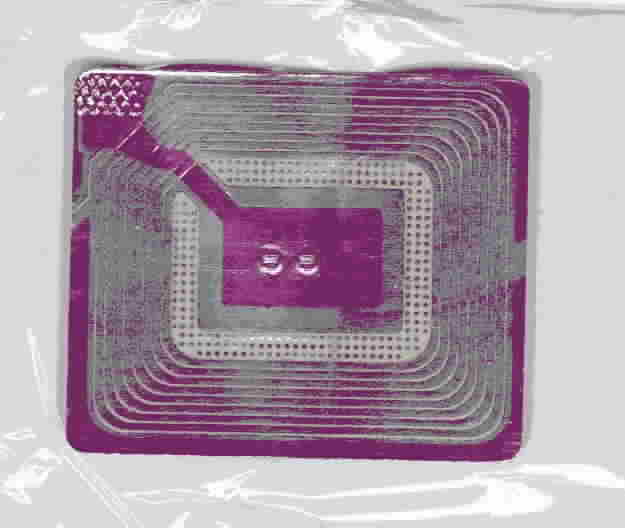
I became interested in these things in the early 1980s, when I first saw the exit devices and the tags appearing on items, and the cashiers were very strict about my having to get those damned things neutralized.
Most people imagine that these things are magnetic 1. Well, I wondered about that and quickly realized that they were not likely to be simple magnets. My reasoning was: 1) too many people are walking around with iron objects, they would set off a magnetic detector all the time, and 2) the ICD is very light and would you would need for the magnetic detectors to be extremely sensitive, so sensitive that they would be detecting every truck and bus that came within 50 feet of the detectors, there is obviously no magnetic shielding around the detectors. So I figured that a magnetometer was out for this arrangement.
I wondered about these things for a little bit. They worked, and they were not giving a lot of false positives. So this had to be something electromagnetic.
And then it hit me. This was radio technology, and rather ancient radio technology at that! I figured that those extremely light ICDs were some sort of a radio circuit. Now obviously they can't have a power source to allow them to be broadcasting 24 hours a day. So they must be very simple circuits.
Well, there are such circuits. They are called Tuned Radio Frequency (TRF) circuits. Basically, these TRF circuits constitute tiny radio receivers which will resonate at a very specific and, you hope, narrow frequency.
Those two towers you see on exiting the store or library are radio transmitters. They put out a very feeble signal on the exact same radio frequency at which the TRF circuit in the ICD is set to resonate. In the presence of this signal the ICD becomes a Parasitic Oscillator. In other words it is receiving the signal from the two towers, it's oscillating. This is exactly how the front end of your radio and TV works, they receive a certain frequency and no others, if everything's working properly.
Now the signal those two towers are putting out is very weak and there is a property of the Parasitic Oscillator that comes to the fore here: it's absorbing the radio frequency energy they put out, just as your radio does. The broadcasting towers are set up to try and maintain a set field strength. When that field strength is lowered, as when the ICD absorbs some of their energy, this can be readily detected. I don't have any inside knowledge about how this detection is accomplished, a quick and dirty way would be to simply monitor the amount of current that the tower transmitters draw, but it's pretty easily done.
When a change in the field density is detected, through whatever means they're using, another circuit is triggered and that sets off those alarms which are supposed to draw the attention of the security guards standing around by the door.
All right, now we know how the ICD system works, but how do you get it to stop working? After all, you need to have people walk out the door with stuff after they've purchased it without setting off the alarm and being harassed by the guards.
There are two ways of accomplishing this, you can either remove the ICD or you can detune it, destroy its ability to oscillate at the exact frequency being broadcast by the two towers.
Most people have seen the older ICDs that are still used on clothing. They're big, white plastic things that are in two parts which are held together by pins that go through the fabric of the clothing, and sometimes tear the weave a little. A special device is used to bend the plastic knobs on those ICDs and unlock the two halves from each other.
The other type of ICD, the one illustrated here, is much cheaper and smaller than the older one and so they are simply deformed and allowed to walk out of the store, effectively neutralized.
To show how this is done we have to discuss the ICD itself a little bit.